
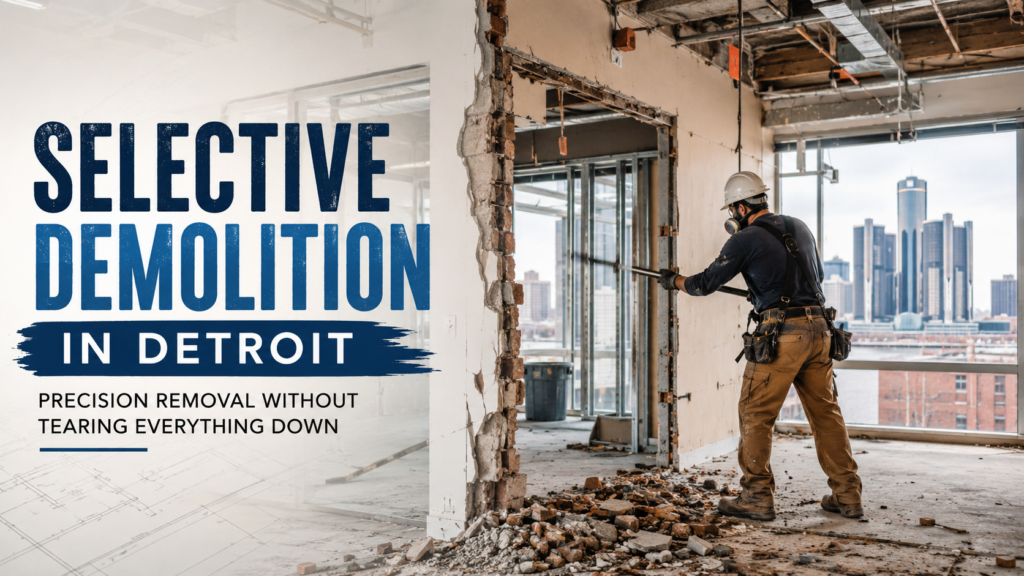
Not every demolition project in Detroit calls for bringing an entire building down. In many renovation, rehabilitation, and adaptive reuse projects across the city and metro region, the goal is to remove specific portions of a structure certain walls, floors, mechanical systems, or finishes while preserving and protecting what remains. This approach is called selective demolition, and it requires a fundamentally different set of skills, tools, and judgment than full-structure teardown. Understanding what Selective Demolition Detroit is and how it works is essential knowledge for property owners, architects, and general contractors planning renovation projects in Detroit.
What Is Selective Demolition?
Selective demolition also referred to as precision demolition, targeted demolition, or strip-out demolition is the controlled removal of specific structural or non-structural elements from a building while preserving the integrity and condition of surrounding elements that are to remain. The work requires careful planning, precise execution, and ongoing attention to the interface between what is being removed and what is being saved.
Selective demolition differs fundamentally from mechanical teardown in its approach. Where full demolition can use large excavators to efficiently break and move material in bulk, selective demolition often relies on a combination of smaller equipment and hand tools reciprocating saws, sledgehammers, pry bars, core drills, and concrete saws that allow operators to work with precision in confined spaces and adjacent to delicate structural elements.
Common Applications in Detroit
Detroit’s built environment creates numerous contexts where selective demolition is the appropriate approach. The city contains a remarkable inventory of architecturally significant commercial, industrial, and institutional buildings from the historic districts of Midtown and Corktown to the industrial buildings of the Poletown area and beyond that are candidates for adaptive reuse rather than teardown. Renovation of these structures almost always requires selective demolition to remove incompatible interior conditions while preserving historic fabric.
Interior renovation and tenant improvement is the most common driver of selective demolition in the commercial market. When a retail space, restaurant, or office is being reconfigured, walls, ceilings, flooring, and mechanical systems from the previous occupant’s buildout must be removed to create a clean shell for the new configuration. This work must be performed without damaging the building structure, electrical distribution, sprinkler systems, and other elements that will remain.
Residential renovation in Detroit represents a substantial market for selective demolition. Whether a Detroit homeowner is updating a kitchen or bathroom, opening a floor plan by removing non-structural walls, or gutting a home affected by fire or water damage for comprehensive rehabilitation, selective demolition is the process that prepares the space for reconstruction. The prevalence of older Detroit homes many built between 1900 and 1960 means that renovation selective demo often encounters historic building materials including plaster walls, original hardwood flooring (to be preserved), tile work, and lathe-and-plaster construction.
Structural modification projects such as adding openings to bearing walls, installing new headers, or removing chimneys require selective demolition with particular attention to structural integrity during the removal process. These operations typically require engineering analysis to confirm how loads will be managed before and after the modification, and the selective demolition work must be sequenced to maintain structural stability throughout.
Planning a Selective Demolition Project
Effective selective demolition begins with thorough documentation and planning. Before any work starts, the existing conditions of the building should be documented through drawings, photographs, and field investigation to establish a clear baseline and identify potential challenges. For older Detroit buildings, field investigation often reveals conditions that differ from any available drawings, requiring adaptation of the demolition plan.
Identifying what is to be removed versus preserved must be precisely communicated to the demolition crew. In design-build projects, this often means the architect marks the building with spray paint or tape to delineate demo limits. Written specifications describing materials to be removed, handling requirements, and protection of adjacent elements are equally important.
Hazardous material assessment is as relevant for selective demolition as for full teardown. In fact, selective demolition can sometimes create more concentrated exposure to hazardous materials than full teardown, because workers are cutting, grinding, and breaking material in enclosed spaces where dust accumulates. Testing for asbestos in floor tile, pipe insulation, joint compound, and ceiling tile and for lead in painted surfaces should precede selective demolition scope in any Detroit building of uncertain age or material composition.
Protection of Remaining Building Elements
A hallmark of quality selective demolition is the condition in which protected elements are left when the work is done. Structural columns, beams, and floors adjacent to removed walls must be protected from damage during demolition operations. Existing mechanical, electrical, and plumbing systems that are to remain must be identified, labeled, and protected or rerouted before work in their vicinity begins.
Temporary structural support is sometimes required during selective demolition of load-bearing elements. When a load-bearing wall is to be removed, for example, the loads it carries must be temporarily supported by shoring before the wall is taken out, and a new beam or header must be installed before shoring is removed. Failing to provide adequate temporary support during selective demolition of bearing elements is a serious safety risk.
Dust control is particularly important in selective demolition because occupied or partially occupied buildings are often the context for this work. HEPA air filtration systems, plastic sheating barriers to isolate the work area, and negative air pressure machines are standard practices in interior selective demolition projects where adjacent areas must be protected from construction dust and debris.
Selective Demolition in Detroit’s Renovation Economy
Detroit’s ongoing revitalization has created robust demand for selective demolition as the renovation and adaptive reuse economy has grown. Projects like the rehabilitation of historic commercial buildings, the conversion of industrial lofts to residential use, and the renovation of Detroit’s historic theaters and cultural institutions all require extensive selective demolition as part of their transformation from obsolete condition to renewed use.
The Detroit Land Bank Authority’s homeownership programs also drive selective demolition demand. Many Land Bank homes are acquired by buyers who undertake rehabilitation rather than teardown, and selective demolition of fire-damaged, water-damaged, or simply outdated interior conditions is the essential first step in making these homes habitable again.
Frequently Asked Questions About Selective Demolition in Detroit
How is selective demolition different from deconstruction? Selective demolition focuses on removing specific elements to prepare a space for renovation, and may not prioritize material salvage. Deconstruction specifically aims to disassemble materials carefully for reuse or resale. In practice, skilled selective demolition often includes opportunistic salvage of reusable materials, but it is not the defining objective.
Do I need a permit for selective demolition in Detroit? Permit requirements depend on the scope. Structural modifications such as removing load-bearing walls require building permits. Interior non-structural demolition (removing flooring, cabinets, non-structural walls) may not require a separate demolition permit, but the renovation work that follows typically requires building permits. Always confirm with the City of Detroit Buildings, Safety Engineering, and Environmental Department for your specific project scope.
Can selective demolition be performed in an occupied building? Yes, with appropriate precautions. Work zone isolation, dust control, temporary utility management, and sequencing of work to minimize disruption are all essential elements of selective demolition in occupied settings. This is common in commercial renovation projects where businesses must maintain operations during construction.